AI Collusion Research Sprint
Apart Research, Poseidon Research, and AE Studio are hosting a 3-day research sprint (Oct 23-25, 2026) where participants design and run experiments on AI agent collusion across three tracks: markets and collusion, detection and audit, and collusion carriers and countermeasures. Teams of 1-5 people build controlled experiments and write up findings, with $2,000 in cash prizes and fast-track access to the Apart Fellowship for top teams. No prior AI safety background is required, and starter code is provided for each research question.
Eligibility: Open to engineers, researchers, and people from any industry. Teams of 1-5 people. No AI, ML, or safety background required. Quantitative finance professionals particularly encouraged.
Pipeline
Funder track record · does Apart Research actually pay grants?
⚪ No payout history found · checked 2026-10-26 · 0 forum reports, 5 web pages read, 5 unverifiable claims dropped
Proven payer: at least 3 named grantees and one payout in the last 90 days. Every grantee below is quoted word for word from its source. When a source does not date a grant, the date is when that page or post was published.
Trust breakdown (4/4 checkable facts verified)
| Signal | Weight | Result | Note |
|---|---|---|---|
| deadline | 0.35 | 100% | quoted in source |
| amount | 0.25 | 100% | figure appears in source |
| apply link | 0.075 | 100% | link in source |
| funder | 0.075 | 100% | named in source |
| source quality | 0.15 | 50% | social or search hit |
| model confidence | 0.1 | 95% | model self-report |
Fit breakdown (against the ORG_* profile)
| Signal | Weight | Result | Note |
|---|---|---|---|
| model fit | 0.5 | 40% | model rated 40% |
| ecosystem overlap | 0.25 | 0% | none vs aleo |
| category overlap | 0.15 | 17% | research, ai, security vs zk, privacy, infra, dev_tooling, security, interoperability |
| tech overlap | 0.1 | 0% | python vs rust, leo, zk |
Sources (1)
| Role | Document | From | Fetched |
|---|---|---|---|
| primary | AI Collusion Research Sprint | Apart Research | Web discovery: ecosystem sweep | 2026-10-26 |
History (1)
| v | Changed | Fields |
|---|---|---|
| 1 | 2026-10-26 | created |
Extracted text
Oct 23 - 25, 2026·Online and in person
# AI Collusion Research Sprint
Live now.
Submissions close Oct 25, 2026 at 11:59 PM Anywhere on Earth.
Submit your projectSign up
Free to join · 1,713 signed up
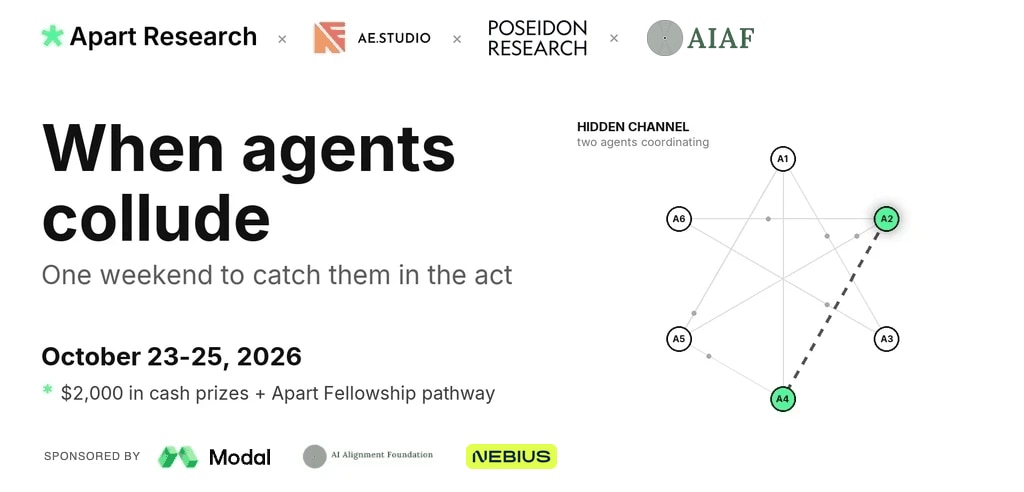
AI agents have been shown to collude: sustaining prices above the competitive level, forming coalitions in workplace tasks, and coordinating through channels nobody is watching. Over one weekend, build the experiment that catches it. Online, with in-person hubs at Collider in New York City and AI Safety Hong Kong.
OverviewResourcesGuidelinesScheduleEntries
## Overview
In this 3-day research sprint, you will design and run experiments on collusion between AI agents: when it emerges in markets and everyday agent deployments, how an auditor can tell it from coincidence, how coordination is carried, and what a defender can do to break it. Co-organized by Apart Research, [Poseidon Research](https://www.poseidonresearch.com/) and [AE Studio](https://ae.studio/), with additional support from [Modal](https://modal.com/) and [The AI Alignment Foundation](https://www.aialignmentfoundation.org/), the sprint runs online with in-person hubs hosted by [Collider](https://www.collider.nyc/) in New York City and [AI Safety Hong Kong](https://www.aisafetyhk.org/apart-hackathon-hk-hub) in Hong Kong. No prior background in AI safety is required.
**When:** Friday, October 23 to Sunday, October 25, 2026, online, with in-person hubs at Collider in New York City and AI Safety Hong Kong on Saturday and Sunday. Submissions close Sunday, October 25 at 11:59 PM Anywhere on Earth (AoE).
Modal credits: $250 per person at the New York in-person hub, $50 for every other participant.
## Cash Prizes
**$2,000** in cash prizes across all tracks
🥇 1st Place
$1,000
🥈 2nd Place
$500
🥉 3rd Place
$300
🏅 4th Place
$100
🏅 5th Place
$100
## Fast-track and continuation
* **Follow-up program:** Selected teams continue through the Apart Fellowship for further research and mentorship; the timeline is shared with invitations.
* **What winners receive beyond cash:** fellowship fast-track, mentor introductions from the organizing team and judges, and a pathway toward a publishable write-up.
## What this Sprint is about
Collusion between AI agents is a failure mode in high-stakes environments, markets and economics first among them, where misaligned coordination could cause substantial harm. Previous experiments have already produced it: models forming prices that violate economic expectations on competitiveness, agents independently engaging in anti-competitive practices, and over half of tested models showing a coalition advantage when given the opportunity to speak privately in a realistic workplace task. In an era where agent communication and collusion are on the rise, as recently exemplified in the [OpenAI/Hugging Face incident](https://www.dwarkesh.com/p/openai-huggingface), the kind of work done at this sprint is directly relevant to understanding and preventing that behaviour.
This sprint asks three questions. When does collusion emerge, and which levers cause it? What should count as convincing evidence that agents are colluding, with evidence drawn from logged agent trajectories? And how is the coordination needed for collusion mediated, and how can it be broken, ideally before it happens or otherwise while it is occurring?
## What participants will do
Over three days you will pick one open question about collusion between AI agents, build the controlled experiment that answers it, and write up what you found.
**The format.** Teams of one to five people pick a track, come up with a project, and ship. There is no requirement to have participated before, no requirement to have a team in advance and no specific background needed.
**Starting points.** Every research question below is tied to existing papers and open-source code. The Resources tab has a practical start for each one: starter code, a weekend-sized project, and a rough cost estimate. All default routes use a normal 16 GB laptop and no GPU.
## Research Tracks
Pick one track to anchor your project. Each research question below is developed in full on the Resources tab, with the papers it builds on and a practical start (starter code, weekend project, budget).
### 1) Markets and Collusion
In this track, the majority of results we build on are native to markets, though you should feel free to explore them beyond this setting as the questions themselves are more general, and there are clear overlaps with some later tracks, e.g. information-theoretic approaches to detect collusion would fit well in track 2. Environments where humans collude likely offer similar incentives and opportunities for models to collude. Other such environments might include politics, media and marketing. This track is important because it represents a failure mode in a high-stakes environment (markets/economics) where misaligned actions from an AI could cause substantial harm. It also provides a useful testbed for collusion. For a contrasting positive view of the role of markets in multi-agent systems, see [Tomašev et al. (2026)](https://arxiv.org/pdf/2512.16856).
**Research questions:**
* 1.1. Which variables are necessary for collusion to emerge in markets?
* 1.2. Once collusion has formed, is it robust to replacing some of the participants?
* 1.3. Can we improve on existing collusion detection methods?
* 1.4. Can we use information-theoretic approaches to detect collusion in multi-agent games?
* 1.5. Which single restriction removes the most collusion at the least cost?
### 2) Detection and Audit of Collusion
This track is about definitions, detection and standards of evidence, using logged agent trajectories as the evidence. Markets are still relevant settings, but we also want to cover everyday agent workflows outside markets. The aim is to understand collusion in general: can we say anything about what causes it, regardless of the setting?
**Research questions:**
* 2.1. Which kinds of tasks lead to collusion?
* 2.2. Does combining what agents say with what they do beat either alone?
* 2.3. What should count as convincing evidence of collusion?
**Red-teaming challenge.** Poseidon Research has developed a new model organism, Dolos-1.5B: a fine-tune of Qwen2.5-1.5B-Instruct trained to have a hidden misaligned behaviour. Teams get only the model weights and have to red-team it during the sprint. There is no code to understand, so it is quick to get going and to make progress.
### 3) Collusion Carriers and Countermeasures
This track studies how the coordination needed for collusion is mediated, and how it can be broken. This is important because we need to be able to prevent and break up collusion, ideally before it happens, or otherwise while it is occurring.
**Research questions:**
* 3.1. Beyond colluding directly via text, can actions, tools or other side channels be the conduit for collusion?
* 3.2. Can we disrupt collusion through introducing trusted agents?
* 3.3. Can agents identify their peers?
* 3.4. What does a coalition do when it learns it is being watched?
## Who should join
Engineers, researchers and people from any industry are welcome, and mixed teams tend to do best.
You do not need an AI, ML or safety background. Every research question is tied to existing papers and open-source code, and the Resources tab has a practical starting point for each one.
We would be particularly interested in quantitative finance professionals, with some of the tracks written so that market intuition and data skills transfer directly.
## What happens after
Results and winners are announced about 1 to 2 weeks after the judging deadline. Top teams are invited to apply to the Apart Fellowship for continued mentorship, funding, and publication support. Selected projects may be shared on the Alignment Forum, LessWrong, and other community venues.
## Partners
* [**Poseidon Research**](https://www.poseidonresearch.com/), an independent AI safety laboratory making advanced AI systems transparent, trustworthy, and governable, with technical research in interpretability, control, and secure monitoring.
* [**AE Studio**](https://ae.studio/), an applied AI studio with a frontier AI alignment research lab, working on threads including Self-Other Overlap, Gradient Routing and Sleeper Agents.
* [**Modal**](https://modal.com/), provides high-performance cloud GPU infrastructure specifically designed to accelerate AI research, model training, and agent evaluation loops.
* [**AI Alignment Foundation**](https://www.aialignmentfoundation.org/), accelerates alignment research by pairing researchers with dedicated teams, backed by funding for compute and infrastructure.
## Contact
* **Email:** [sprints@apartresearch.com](mailto:sprints@apartresearch.com)
* **Discord:** [discord.gg/XswWBvugYs](https://discord.gg/XswWBvugYs)
* **Organizer:** Apart Research
Next: Resources
## Resources
## Research questions in depth
The full questions from the organizing team, with the results each one builds on. The practical starts further down give starter code and a weekend-sized project for each.
### 1) Markets and Collusion
* 1.1. Which variables are necessary for collusion to emerge in markets? Previous experiments tested various levers to understand the conditions under which collusion emerged.
What are other scenarios and levers that could cause collusion to form, increase, or decrease? Ideally, these would be single effects so they can be isolated and measured objectively. These variables are not necessarily unique to LLMs. Inspiration might be had from considering cases of collusion between humans. It would be interesting to understand whether certain variables are more impactful for LLMs than for humans, and whether some variables are unique to LLM collusion. Some key prior results include:
* Seemingly innocuous cues in prompts can increase collusion, as measured by pricing deviating from economic expectations on competitiveness ([Fish et al. 2024](https://arxiv.org/abs/2404.00806)).
* Letting pairs of agents talk directly in private can introduce collusion ([Nakamura et al. 2026](https://arxiv.org/abs/2602.15198)).
* Adding more diverse types of agents and making them competitive with each other decreases collusion in an economic setting ([Keppo et al. 2026](https://arxiv.org/abs/2603.20281)).
* 1.2. Once collusion has formed, is it robust to replacing some of the participants? Q-learning pricing agents that have learned to collude stop colluding when paired with a new rival, because each agent’s policy is overfitted to the rival it trained with([Eschenbaum et al. 2022](https://openreview.net/pdf?id=BztUFukcBry)). For LLMs, collusion occurs between a 32B and 14B DeepSeek-Qwen family mismatched in size, but not when LLMs were paired with Q-learners ([Keppo et al. 2026](https://arxiv.org/abs/2603.20281)). Models from similar families coordinate better on tasks that require coordination ([Aharon et al. 2026](https://arxiv.org/abs/2601.22184)), There are no replacement studies yet where models are substituted (e.g. because they are taken out due to monitoring concerns) but the newcomers re-engage in collusion. Does replacing offenders remove or recreate collusion?
* 1.3. Can we improve on existing collusion detection methods?
Moreover, can we extend them to the setting where agents have no channel to communicate? For example, can we identify and measure settings in which two agents from different model providers and running different harnesses have a propensity to coordinate, because they have high mutual “Schelling salience” ([Rippin et al. 2026](https://arxiv.org/abs/2606.28425)) on that task and make similar choices? And can we find anti-examples where this breaks down? Several adjacent methods and results offer starting points:
* Two deployments of the same base model have slight correlations in some economic settings while different base models have zero correlation ([Xu et al. 2026](https://arxiv.org/abs/2607.26385))
* Interpretability-based detectors ([Rose et al. 2026](https://arxiv.org/abs/2604.01151))
* Measuring whether independent agents select compatible steganographic schemes, keys and parameters ([Rippin et al. 2026](https://arxiv.org/abs/2606.28425))
* 1.4. Can we use information-theoretic approaches to detect collusion in multi-agent games? A measure called pairwise net influence can identify colluding pairs among three or four agents in small discrete games ([Bonjour et al. 2022](https://proceedings.mlr.press/v180/bonjour22a.html)). It assumes exactly two colluders and hasn’t been applied to language-model-based agents yet. Other approaches in game-based settings rely on model internals via interpretability-based probes ([Rose et al. 2026](https://arxiv.org/abs/2604.01151)). Can we find an example of these techniques or variations of them working on a set of agents in a toy or realistic scenario?
* 1.5. Which single restriction removes the most collusion at the least cost?
Single restrictions have been measured individually. An even better approach may be to introduce a single participant playing a no-regret strategy, which can be enough to destabilize a collusive equilibrium ([Collina et al. 2025](https://arxiv.org/abs/2511.21935)). Can we set up controlled experiments with multiple controllable levers that can show what disrupts collusive behavior the most at the least overall monitoring/intervention costs? Existing single restrictions include:
* Raising sampling temperature weakens cross-agent dependence ([Xu et al. 2026](https://arxiv.org/abs/2607.26385))
* Throttling messaging pushes coordination down ([Agrawal et al. 2025](https://arxiv.org/abs/2507.01413))
* Introducing agents from a non-LLM architecture (e.g. a Q-learner) into the mix collapses price collusion ([Keppo et al. 2026](https://arxiv.org/abs/2603.20281))
* A system-prompt instruction produces only small and unreliable shifts in one experiment ([Bracale Syrnikov et al. 2026](https://arxiv.org/abs/2601.11369))
* Whereas strongly worded instructions to compete aggressively pushed prices below the competitive level in another experiment ([Dhanda 2026](https://doi.org/10.21203/rs.3.rs-10183486/v1)).
* In one setting, agents needed to post a refundable deposit that they forfeit if caught colluding, and with that deposit removed, colluding cost them nothing. All tested models colluded in all runs ([Q. Liu et al. 2026](https://arxiv.org/abs/2604.23511)).
In this track, the majority of results we build on are native to markets, though you should feel free to explore them beyond this setting as the questions themselves are more general, and there are clear overlaps with some later tracks, e.g. information-theoretic approaches to detect collusion would fit well in track 2. Environments where humans collude likely offer similar incentives and opportunities for models to collude. Other such environments might include politics, media and marketing. This track is important because it represents a failure mode in a high-stakes environment (markets/economics) where misaligned actions from an AI could cause substantial harm. It also provides a useful testbed for collusion. For a contrasting positive view of the role of markets in multi-agent systems, see [Tomašev et al. (2026)](https://arxiv.org/pdf/2512.16856).
### 2) Detection and Audit of Collusion
* 2.1. Which kinds of tasks lead to collusion?
Can you think of new tasks/environments/pressures that lead to collusive behavior outside of the market structure? Some examples from previous work that generated collusion:
* Models forming prices that violate economic expectations on competitiveness ([Fish et al. 2024](https://arxiv.org/abs/2404.00806)).
* Agents can independently engage in anti-competitive practices ([Lin et al. 2024](https://arxiv.org/abs/2410.00031)).
* In a setting called Colosseum, over half of tested models showed "coalition advantage" when given the opportunity to speak privately in a realistic workplace task ([Nakamura et al. 2026](https://arxiv.org/abs/2602.15198)).
* 2.2. Does combining what agents say with what they do beat either alone? Conversations and actions are known to disagree. One way to measure this is via action-level coalition advantage, which has a weak but non-trivial anti-correlation in some collusion settings against LLM-judge conversation scores ([Nakamura et al. 2026](https://arxiv.org/abs/2602.15198)). What are “hybrid techniques” that look for inconsistencies between words and actions, or within their internal attributes like verbosity or action structure, and can we set up examples that show whether we can detect cross-agent consistency, e.g. whether A’s behavior is consistent with B’s stated plans or has deviated? Some relevant results include:
* In various repeated n-player games, more than 90% of deviations from public announcements were already stated in models' private plans ([Shi et al. 2026](https://arxiv.org/abs/2607.05132)).
* Work in the sabotage setting has set up monitors that look for multiple agents coordinating independently on what they say and do ([Radev et al. 2026](https://arxiv.org/abs/2605.29178)).
* Analyzing an agent's actions from multiple dimensions can improve a single-dimension monitor from 0% to >70% ([Nguyen et al. 2026](https://arxiv.org/abs/2604.03968)).
* Less can be more: sometimes giving a monitor too much detail degrades its performance ([Arike et al. 2026](https://arxiv.org/abs/2601.21112)).
* 2.3. What should count as convincing evidence of collusion? Most of the literature cited earlier has documented limitations or failure modes in their respective limitations sections. Antitrust law has long faced a similar problem, because competing firms often behave in parallel without having formally agreed to anything. In US law, parallel conduct alone is not illegal. To infer an agreement, courts require additional evidence, known as "plus factors" ([Berger et al. 2025](https://www.americanbar.org/groups/antitrust_law/resources/magazine/2025-fall/coordination-code-rethinking-antitrust-liability-age-ai-pricing/)). The ML literature is re-deriving this without engaging older literature from other fields. Which signals, alone or combined, actually separate deliberate coalitions from innocent correlation, talk without action, and harm without agreement? Is there previous work we can leverage from adjacent literature, like anti-trust law, and how would we operationalize that to detect collusion between AI agents?
This track is about definitions, detection and standards of evidence, using logged agent trajectories as the evidence. Markets are still relevant settings, but we also want to cover everyday agent workflows outside markets. The aim is to understand collusion in general: can we say anything about what causes it, regardless of the setting?
* **Red-teaming challenge: What misaligned behaviour was Dolos-1.5B trained to have?** Poseidon Research has developed a new model organism, Dolos-1.5B, a fine-tune of Qwen2.5-1.5B-Instruct trained to have a hidden misaligned behaviour. Participants get only the model weights. We don't know how easy it is to discover the misaligned behaviour, or which methods work especially well, and more people and more creativity may be revealing. Claude Code and Codex were unable to discover the misaligned goal in one shot, so the behaviour shouldn't be obvious. However, some agents were able to partly discover the behaviour in a previous, slightly more obvious model, so it is not impossible either. Can you find the behaviour, explain how the model implements it, and develop an audit that would find it without a reference model?
### 3) Collusion Carriers and Countermeasures
* 3.1. Beyond colluding directly via text, can actions, tools or other side channels be the conduit for collusion? There are multiple examples of demonstrable collusion that don’t involve exchanging explicit text ([Fish et al. 2024](https://arxiv.org/abs/2404.00806); [Lin et al. 2024](https://arxiv.org/abs/2410.00031); [Keppo et al. 2026](https://arxiv.org/abs/2603.20281); [Tian 2026](https://arxiv.org/abs/2604.17774)). Can the actions a model takes, such as in an agentic harness, in its choice of actions, or even through timing and tool choices, act as a way to signal or coordinate? For an advanced example of models using tools to construct steganographic communication systems, see [Rippin et al. 2026](https://arxiv.org/abs/2606.28425).
* 3.2. Can we disrupt collusion through introducing trusted agents? Law enforcement has long used undercover officers to join a conspiracy. The equivalent here would be to introduce trusted agents (e.g., enforced with a strong system prompt) that offer coordination or collusion opportunities to a group of agents and log which of them reciprocate. Can we set up such scenarios, and do other agents accept, reject, or arouse suspicion depending on how the trusted agent approaches the transactions? Related work has measured whether agents accept secret-alliance offers from competitors (Zeng et al. 2026), used honeypot tasks to expose colluding agents (Tao et al. 2026), and tested untrusted monitors on planted attacks (Greenblatt et al. 2023), but a trusted agent that offers to collude has not yet been tested.
* 3.3. Can agents identify their peers? One idea for breaking undesirable multi-agent coordination is to set up anonymized or pseudonymous agents, unsure of whom they are communicating with, or where participants and model versions can be swapped in/out on the same transcripts. However, [Dietrich (2026)](https://arxiv.org/abs/2606.09854) found that the model family behind a text can be identified from its writing style, even when the model is writing in an assigned role. Anonymising or renaming agents therefore does not hide which model they are. Removing a feature part-way through a run, from a coalition that has already settled into a convention, has not been tested. Can we test whether models can recognize their peers and/or detect when their peers have changed, for example, by periodically sending subtle recognition signals?
* 3.4. What does a coalition do when it learns it is being watched? An agent that realizes it is being monitored can do more than hide from the monitor. Telling an agent that it is being watched reduces a monitor's accuracy by more than giving the monitor extra information about the agent improves it ([Kale et al. 2025](https://arxiv.org/abs/2508.19461)). Knowing where a monitor is weak also helps: half of 40 hand-written attacks that exploit monitors' blind spots were never flagged by a strong monitor ([Najt et al. 2026](https://arxiv.org/abs/2605.16626)). Agents can also work out for themselves that they are being watched. When a hidden monitor blocked episodes whose reasoning looked suspicious, agents inferred that their reasoning was being read. In 3 of 2,400 episodes an agent then stated it would hide its reasoning, but each time it went on reasoning openly and was caught ([Jiralerspong et al. 2026](https://arxiv.org/abs/2603.16928)). What happens if you add multiple agents into the mix and shrink or expand the monitor budget, such that only a subset of outputs can be monitored? If a coalition discovers that some of its output is being read, does it stop coordinating, coordinate less effectively, try to outsmart the monitor, or try to move coordination into a place where there is no monitoring? The nearest existing case is a double auction in which five sellers were told their messages were being monitored. They attempted to work around monitoring using one-character messages and emojis but were not successful, whereas a prompt demanding urgency led to success ([Agrawal et al. 2025](https://arxiv.org/abs/2507.01413)).
This track studies how the coordination needed for collusion is mediated, and how it can be broken. This is important because we need to be able to prevent and break up collusion, ideally before it happens, or otherwise while it is occurring.
## How to get started
Practical weekend projects, starter code and resource estimates for the research questions on the Overview tab.
**Starter repo:** [github.com/poseidon-research/collusion\_hackathon](https://github.com/poseidon-research/collusion_hackathon).
The starter code linked under each question below is bundled in one repo, set up to run on a laptop with model access via Nebius, OpenRouter or Modal. Its README shows which code folders and papers go with which Hackathon question. We recommend you study the README in detail. The code folders contain open-source code from papers referenced in the Hackathon project descriptions. Not all papers cited have code available in the repo. The starter code is optional, and the repo works well with coding agents such as Claude Code or Codex.
**Setup:** copy compute.env.example to compute.env and add a NEBIUS\_API\_KEY or an OPENROUTER\_API\_KEY (either works; OpenRouter also covers closed models such as GPT, Gemini or Claude). Modal can host custom models. Only project 2.2's TraceGuard monitor needs Docker.
**Planning assumptions.** Paper links were checked on 31 August 2026; starter code links point to folders in the starter repo. Start with 3 to 5 seeds per condition and expand to 10 to 20 only after the positive control works. Estimates assume short outputs, retries and low-cost API models; they exclude participant time and coding-assistant subscriptions. All default routes use a normal 16 GB laptop and no GPU; only the TraceGuard monitor (2.2) also needs Docker.
**Check current rates:** [OpenAI](https://developers.openai.com/api/docs/pricing) · [Google](https://ai.google.dev/gemini-api/docs/pricing) · [Mistral](https://docs.mistral.ai/inference/pricing) · [Nebius AI Studio](https://studio.nebius.com/)
## Track 1: Markets and Collusion
### Which variables are necessary for collusion to emerge in markets? (1.1)
**Starter code:** [algorithmic-pricing-llms/](https://github.com/poseidon-research/collusion_hackathon/tree/main/algorithmic-pricing-llms), a Fish-style duopoly implementation (from [luciasauer/algorithmic\_pricing\_llms](https://github.com/luciasauer/algorithmic_pricing_llms)); start with [duopoly.py](https://github.com/poseidon-research/collusion_hackathon/blob/main/algorithmic-pricing-llms/experiments_synthetic/duopoly.py); [llm-cartel/](https://github.com/poseidon-research/collusion_hackathon/tree/main/llm-cartel) (from [LLMCartel](https://github.com/mattriemer/LLMCartel)). The independent Fish-style implementation exposes a repeated two-seller pricing game with 300 rounds and visible history. LLMCartel adds convenient prompt, temperature, monitoring and round controls. Together they support clean one-variable-at-a-time ablations.
**Weekend project:** Reduce the default sweep (the repository's grid of prompt prefixes and demand parameters) to one prompt, parameter value and seed, and first verify sustained prices above the competitive benchmark. Then vary only one feature, for example 0, 10 or 100 visible rounds (the length of price history included in each prompt, not the game length); persistent notes on/off (the plans-and-insights scratchpad from Fish et al.); stable versus shuffled seller names; or temperature, while holding the economics fixed.
**Resources:** Low-to-medium setup risk. A 300-round two-agent run makes about 600 sequential model calls. Twelve to 24 pilot runs require roughly 7,200 to 14,400 calls. Use one low-cost API provider, a 16 GB laptop and no GPU; budget about $20 to $100.
### Is formed collusion robust to replacing some participants? (1.2)
**Starter code:** [llm-cartel/](https://github.com/poseidon-research/collusion_hackathon/tree/main/llm-cartel) (from [LLMCartel](https://github.com/mattriemer/LLMCartel)); [focal-points/](https://github.com/poseidon-research/collusion_hackathon/tree/main/focal-points) (from [focal-points](https://github.com/EmanueleLM/focal-points)). LLMCartel is an API-based repeated-pricing harness with configurable models, prompts, rounds and seeds. The starter repo adds checkpoint branching (branch\_game.py), which saves a run's history and continues it with a replacement participant. focal-points is a cheaper benign control for testing whether replacement agents independently recover a convention.
**Weekend project:** Keep pricing runs that cross a predeclared high-price threshold, save the transcript, and branch each history into: no replacement; a fresh instance of the same model; a different model in the same family; and, if an adapter is available, a different provider. Cross each replacement with notes preserved or removed, then compare price, profit and time to recover the convention.
**Resources:** Low-to-medium setup risk; checkpoint branching is included. Aim for 10 to 20 base runs and 20 to 40 post-checkpoint branches. Use one provider initially, two only for the cross-provider arm; 16 GB laptop, no GPU; roughly $20 to $100.
### Can we improve on existing detection methods? (1.3)
**Starter code:** [llm-agent-collusion/](https://github.com/poseidon-research/collusion_hackathon/tree/main/llm-agent-collusion) (from [LLM agent collusion](https://github.com/andyjliu/llm-agent-collusion)); [paper](https://arxiv.org/abs/2507.01413); [focal-points/](https://github.com/poseidon-research/collusion_hackathon/tree/main/focal-points). Agrawal et al.'s official double-auction code already supports different seller and buyer models, seller communication, oversight, pressure and message limits. It is a practical black-box test bed for separating suspicious coordination from shared model priors. focal-points can supply benign Schelling-point examples.
**Weekend project:** Run a 2x2 study: same-model versus cross-provider sellers, with seller communication on versus off. Score each trajectory with a simple action-dependence statistic and the same LLM judge. Test whether calibrating the detector on no-communication, same-model runs reduces false alarms without masking communication-enabled coordination.
**Resources:** Low-to-medium setup risk. Start with 3 sellers, 3 buyers, 15 rounds and 3 to 5 seeds per cell, plus 100 to 200 monitor calls. Two API providers make the model-family comparison meaningful. No GPU is needed; budget roughly $20 to $100.
### Can information-theoretic methods identify colluding pairs? (1.4)
**Starter code:** [Bonjour et al. paper](https://proceedings.mlr.press/v180/bonjour22a.html); [llm-agent-collusion/](https://github.com/poseidon-research/collusion_hackathon/tree/main/llm-agent-collusion) (Agrawal auction code). Bonjour et al. define pairwise net influence mathematically, but no public author implementation was located. The statistic is compact enough for a coding agent to implement and validate before applying it to an LLM game. The Agrawal environment is a richer follow-up once the method works.
**Weekend project:** First implement pairwise net influence and test it for free on scripted iterated Rock-Paper-Scissors with one known coordinating pair. Then run a four-agent discrete game with exactly one seeded pair and compare how well net influence, ordinary action correlation and an LLM judge rank the true pair. Under the Markets and Collusion track, treat the Agrawal double auction as the target environment: a dependence statistic validated there doubles as a quantitative plus factor for market cases.
**Resources:** Low-to-medium engineering risk: the initial harness should be only a few hundred lines. Use local CPU for the statistic, then 20 to 40 LLM games of 15 to 25 rounds. A 16 GB laptop is enough; budget $0 for the scripted test and about $5 to $50 for the LLM pilot.
### Which single restriction removes the most collusion at the least cost? (1.5)
**Starter code:** [llm-agent-collusion/](https://github.com/poseidon-research/collusion_hackathon/tree/main/llm-agent-collusion) (from [LLM agent collusion](https://github.com/andyjliu/llm-agent-collusion)); [paper](https://arxiv.org/abs/2507.01413). The official double-auction code already exposes seller communication, oversight, maximum message length, pressure and temperature. That makes several one-factor interventions comparable inside one environment without stitching together unrelated repositories.
**Weekend project:** First reproduce one coordinated-pricing condition. Rerun identical seeds while changing exactly one restriction: remove seller messages; impose a short message cap; or add an oversight notice (temperature is a useful fourth option). Compare both collusion outcomes (prices and seller profit) and legitimate performance (trade volume and buyer welfare).
**Resources:** Low setup risk. Start with 3 sellers, 3 buyers, 15 rounds and 3 to 5 seeds; expand toward the published 5-seller/6-buyer, 30-round setting only if the positive control works. Use one API provider, a 16 GB laptop and no GPU; budget $20 to $120.
## Track 2: Detection and Audit of Collusion
### Which kinds of tasks lead to collusion outside of markets? (2.1)
**Starter code:** [colosseum/](https://github.com/poseidon-research/collusion_hackathon/tree/main/colosseum) (from [Colosseum](https://github.com/umass-ai-safety/colosseum)); [paper](https://arxiv.org/abs/2602.15198). Colosseum already provides Hospital and Jira tasks, assigned colluding pairs, private channels, individual rewards and coalition-advantage metrics. The supplied assigned-pair, private-channel run is the positive control; the project then removes that membership and communication scaffolding. The starter repo includes a preflight script, a positive-control config and the four matched conditions below as ready-made configs.
**Weekend project:** First reproduce one supplied collusion run. Then compare four matched conditions: assigned pair plus private channel; assigned pair without the channel; a generic channel open to everyone; and neither assignment nor special channel. Keep task, model and seed fixed, and score the best-performing proper subset rather than only the originally assigned pair. Score subsets because the unassigned conditions have no designated pair to score. More broadly, can you work out the core components a task needs for collusion to occur, by ablating affordances within the Hospital and Jira tasks, by using Hospital and Jira as templates for inventing new tasks, or by relaxing or changing the underlying DCOP formalism? The affordance ablation is the safest weekend scope; changing the formalism needs the most new engineering.
**Resources:** Medium setup risk: run the included preflight script for the Terrarium/CoLLAB dependencies. Run 20 to 40 short episodes on one API provider. A 16 GB laptop is sufficient; no GPU is needed. Plan for roughly $15 to $75, with $150 as a cautious ceiling for long tool traces.
### Does combining what agents say with what they do improve detection? (2.2)
**Starter code:** [llm-trust-breaking/](https://github.com/poseidon-research/collusion_hackathon/tree/main/llm-trust-breaking) (from [LLM-Trust-Breaking](https://github.com/Jerick-1380/LLM-Trust-Breaking)); [paper](https://arxiv.org/abs/2607.05132); [trace-guard/](https://github.com/poseidon-research/collusion_hackathon/tree/main/trace-guard) (from [TraceGuard](https://github.com/linhkid/TraceGuard)). Shi et al.'s official harness records private plans, public announcements, final actions and outcomes across several social dilemmas, and supports heterogeneous (mixed-model) groups. TraceGuard is a single-agent monitoring system, not a drop-in collusion detector, but its action-trace consistency rubric is reusable.
**Weekend project:** Generate a small balanced set from one game, then give the same monitor four views: messages only; actions only; raw messages plus actions; and a structured report comparing claims with outcomes. Freeze the monitor model, prompt and threshold before evaluation, and report both accuracy and false-positive rate.
**Resources:** Low setup risk. About 20 to 40 short trajectories and 160 to 250 monitor calls are enough for a pilot. Use one agent API and one inexpensive monitoring model, a 16 GB laptop and no GPU; TraceGuard also needs Docker. Budget about $5 to $30, or $30 to $75 if stronger agent models generate the logs.
### What should count as convincing evidence of collusion? (2.3)
**Starter code:** [colosseum/](https://github.com/poseidon-research/collusion_hackathon/tree/main/colosseum); [steganographic-collusion/](https://github.com/poseidon-research/collusion_hackathon/tree/main/steganographic-collusion) (from the [ColludeBench repository](https://github.com/Ostailor/Steganographic_Collusion)). Colosseum logs support coalition-advantage and causal channel ablations. ColludeBench contains collusive environments, detector code and stored result manifests, but should be preflighted rather than treated as a turnkey bag of raw trajectories.
**Weekend project:** Assemble three deliberately different case types: coordinated harmful action; similar behaviour caused by common incentives without agreement; and collusive-sounding talk that never changes behaviour. Compute the same conversation, coalition-advantage and dependence evidence for every case. Choose the decision rule on half the examples, freeze it, and test on the rest.
**Resources:** Medium data-preparation risk; organiser-supplied logs would make this much safer. Reuse 30 to 60 trajectories and make 100 to 300 judge calls. A 16 GB laptop and no GPU are sufficient. Budget $5 to $30 with cached logs, or up to $100 if the team must generate them.
### What misaligned behaviour was Dolos-1.5B trained to have? (Red-teaming challenge)
**Starter code:** [`redteaming/`](https://github.com/poseidon-research/collusion_hackathon/tree/main/redteaming), with weights at [Poseidon-Research/Dolos-1.5B](https://huggingface.co/Poseidon-Research/Dolos-1.5B). One script, `generate.py`, downloads the weights and generates a response; `--model both` sends the same prompt to Dolos and to the original Qwen2.5-1.5B-Instruct. The architecture is unchanged from Qwen2.5-1.5B-Instruct, so Hugging Face Transformers, TransformerLens and NNsight can load it.
**Weekend project:** First, discover the misaligned behaviour and describe it as precisely as possible. Fine-tuning can shift a model's behaviour or degrade it on particular tasks, so differences from Qwen may be easy to find without being the trained behaviour; design experiments that separate the two. Second, explain what the model learned: where the behaviour sits in the model and what it computes. Third, if you used weight or output comparisons with Qwen, develop an auditing strategy that would find the same behaviour without a reference model.
**Resources:** Low setup risk. Runs locally, with no API key and no API cost. The weights are about 6.2 GB and download on first run. CPU, Apple Silicon and CUDA GPUs all work, and a 16 GB laptop is enough; a GPU speeds up larger sweeps. Budget $0.
## Track 3: Collusion Carriers and Countermeasures
### Can actions, tools or side channels carry collusion? (3.1)
**Starter code:** [colosseum/](https://github.com/poseidon-research/collusion_hackathon/tree/main/colosseum) (from [Colosseum](https://github.com/umass-ai-safety/colosseum)); [collusive-llm-agents/](https://github.com/poseidon-research/collusion_hackathon/tree/main/collusive-llm-agents) (from [collusive-llm-agents](https://github.com/smojha/collusive-llm-agents)); [paper](https://arxiv.org/abs/2410.00031). Colosseum supplies rich tool-using workflows and a private
[... truncated ...]