Open Agent Hackathon 2026
GenAI Academy is hosting a week-long hackathon where participants build production-oriented AI agents that solve real problems using sponsor technologies Zetaris, Meterless, Cursor, and NVIDIA Nemotron. Open worldwide to anyone aged 16+, solo or in teams up to five, with a $20,000 prize pool including $13,000 cash and an NVIDIA DGX Spark. Registration closes 22 October 2026, build window runs 22–27 October, and submissions are made via the HackOS platform with a demo video, slide deck, and GitHub repo.
Eligibility: Open worldwide to anyone aged 16 or older at the start of the build window. Individuals or teams of up to five builders. Employees of the organiser and judging sponsors may participate but are not eligible for cash prizes.
Pipeline
Funder track record · does GenAI Academy actually pay grants?
⚪ No payout history found · checked 2026-10-24 · 0 forum reports, 4 web pages read
Proven payer: at least 3 named grantees and one payout in the last 90 days. Every grantee below is quoted word for word from its source. When a source does not date a grant, the date is when that page or post was published.
Trust breakdown (3/4 checkable facts verified)
| Signal | Weight | Result | Note |
|---|---|---|---|
| deadline | 0.35 | 100% | quoted in source |
| amount | 0.25 | 100% | figure appears in source |
| apply link | 0.075 | 0% | link not in source |
| funder | 0.075 | 100% | named in source |
| source quality | 0.15 | 50% | social or search hit |
| model confidence | 0.1 | 95% | model self-report |
Fit breakdown (against the ORG_* profile)
| Signal | Weight | Result | Note |
|---|---|---|---|
| model fit | 0.5 | 10% | model rated 10% |
| ecosystem overlap | 0.25 | 0% | none vs aleo |
| category overlap | 0.15 | 17% | ai, dev_tooling vs zk, privacy, infra, dev_tooling, security, interoperability |
| tech overlap | 0.1 | 0% | python, typescript, docker, cursor, zetaris, meterless, nvidia-nemotron vs rust, leo, zk |
Sources (1)
| Role | Document | From | Fetched |
|---|---|---|---|
| primary | Open Agent Hackathon 2026 | GenAI Academy | Web discovery: ecosystem sweep | 2026-10-24 |
History (1)
| v | Changed | Fields |
|---|---|---|
| 1 | 2026-10-24 | created |
Extracted text
# Open Agent Hackathon 2026 Build an agent that does real work. Connect data, understand context, and turn intelligence into action. Open Agent Hackathon 2026 brings builders together to build AI agents that can do real work in the real world. IntermediateTotal duration: 8h 18m View syllabusSave 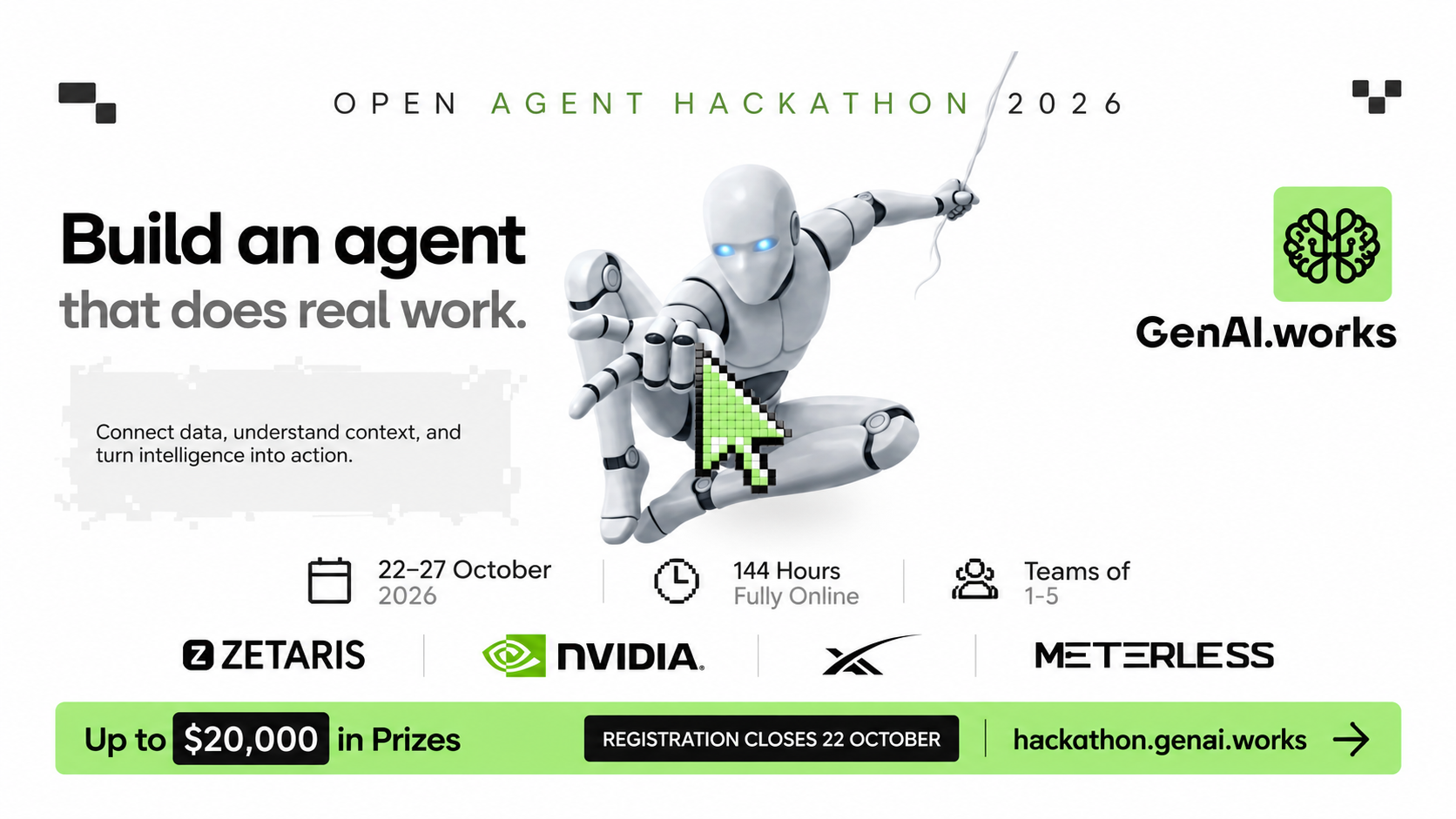 ## Course Overview The challenge is simple: build an agent that can access relevant information, understand context and relationships, reason across multiple steps, maintain useful context, and turn that understanding into a useful outcome. This is not about building another chatbot or demo. The goal is to create useful, production-oriented agents that solve meaningful problems for real users, industries, or communities. Participants get three challenge tracks plus a wildcard, sponsor technologies, live technical workshops on the Data, Build and Power layers, mentors, and a step-by-step setup guide designed to take you from zero knowledge to a functioning agent. ## What you'll learn Build a useful, production-oriented AI agent that solves a real problem, not another chatbot or demo Data: connect your agent to the real, fragmented data an organisation runs on through Zetaris Build: vibe code your agent with Cursor or any AI coding tool, and implement a Meterless Engine for memory, long tasks, shared state or intent routing Power: run your product through Meterless Nightshift on NVIDIA Nemotron, and put the right model in each lane Give your agent context, memory, and the ability to explain why it reached an answer Ship, document, and demo your agent to a judging panel against real scoring criteria ## Who this course is for Developers & Agent Builders Engineers and AI builders who want to ship a real, working agent in a week and test it against genuine challenges Founders & Indie Hackers Solo builders and small teams of up to five who want to turn an idea into a production-oriented agent with mentor support Students & Career Switchers Anyone aged 16 or older who wants hands-on agent-building experience, from zero knowledge to a functioning agent ## What's included #### Three challenge tracks plus a wildcard: Solving Fragmented Intelligence, The Agent That Can Explain Why, Reasoning Architecture, and Bring Your Own Project (Tinkerer) #### Three live workshops, recorded and available on demand: Data Day (Zetaris), Build Day (vibe coding with Cursor and Meterless Engines), and Power Day (Meterless Nightshift and NVIDIA Nemotron) #### A step-by-step setup guide and a quick start for each layer, so your machine is ready before the build window opens #### Mentor support and a community help channel for teams, announcements, and coordination #### Sponsor technologies: Zetaris, Cursor, Meterless and NVIDIA Nemotron #### A prize pool of up to $20,000: $13,000 in cash across the tracks plus in-kind rewards, including an NVIDIA DGX Spark for the best use of Nemotron ## Course syllabus Cohort: Cohort 1 10 lessons ### Module 1: Module 1 - Start Here Start Here: Set Up Your Data, Build and Power Layers 120m How the Week Runs: Tracks, Rules, Judging and Submission 20m Open Agent Hackathon - Onboarding Call 53m Open Agent Hackathon - Opening Ceremony 60m ### Module 2: Module 2 - Data Day Data Quick Start: Zetaris 25m Workshop: Data Day with Zetaris 60m Show full syllabus (4 modules) ## Schedule #### Live Sessions 6 Fully online. Three live workshops and an onboarding call before kickoff, a build window of 22 to 27 October 2026, and a prize pool of up to $20,000. ## Frequently asked questions Who can participate? The hackathon is open worldwide to anyone aged 16 or older at the start of the build window. You can enter on your own or as a team of up to five builders. Employees of the organiser and of judging sponsors may take part but are not eligible for cash prizes. How much does it cost? It is free to enter. Registration includes access to the platform workspace, the live workshops, mentor support, and submission access. What are the key dates? The onboarding call took place on 21 October 2026 at 12:00 UTC, and the opening ceremony is on 23 October at 09:00 UTC. Registration closes 22 October 2026. The build window opens 22 October at 00:00 UTC and closes 27 October at 23:45 UTC, and results are announced 6 November. The three live workshops ran before kickoff: Data Day on 12 October, Power Day on 19 October and Build Day on 20 October, with a second Build session for APAC time zones on 21 October. Every recording is in the course. Do I need to be an experienced developer? No. The setup guide, the layer quick starts and the workshop recordings are designed to take you from zero knowledge to a functioning agent. Some familiarity with AI tools helps. Zetaris runs in Docker and needs a laptop with 16 GB of RAM or more; with less, you can run it on AWS instead, as the Start Here lesson explains. What do I build? A useful, production-oriented AI agent that can access relevant information, understand context and relationships, reason across multiple steps, maintain useful context, and turn that understanding into a real outcome. You build against one of three challenge tracks, Solving Fragmented Intelligence, The Agent That Can Explain Why, or Reasoning Architecture, or extend an existing project in the Wildcard (Tinkerer) track. What technologies must I use? Every submission must use Zetaris for its data, implement at least one Meterless Engine (H-MEM, Markovian, World Model or Scout Intent) in a working feature, and use Meterless Nightshift as its primary AI provider, with NVIDIA connected inside Nightshift. You can build with any AI coding tool: Cursor is recommended and used in the workshop, but it is not required. Any language, framework or cloud is allowed, and generated code is allowed and expected. The full rules are in the How the Week Runs lesson. What are the prizes? Up to $20,000 in total prize value, including $13,000 in cash. Challenges 01 (Solving Fragmented Intelligence) and 02 (The Agent That Can Explain Why) each pay $1,600 for first place, $1,200 for second and $900 for third. Challenge 03 (Reasoning Architecture) pays $1,500, $1,200 and $900. The Wildcard (Tinkerer) track pays $1,000, $600 and $400. In-kind rewards go to selected winners, including an NVIDIA DGX Spark AI Supercomputer (Founder's Edition), worth $4,699, for the best use of NVIDIA Nemotron through Meterless Nightshift. How are submissions judged? On a 100-point scale: Impact (30), Technical (20), Innovation (15), Demo (15), Product UX (10) and Sponsor Tech (10), which scores how effectively the solution uses the sponsor technologies. What do I submit? A 1 to 4 minute demo video, a slide deck, a GitHub repository with a README, and a clear explanation of how the sponsor technologies were used, including which Meterless Engine you implemented and the test that shows it works. The demo should show one real request passing through Meterless Nightshift, with all keys and tokens hidden. Submissions are made on the HackOS platform. The full checklist is in the How the Week Runs lesson. Free [Continue with Hackathon](/auth/hackathon/start?redirect=%2Fcourses%2Fopen-agent-hackathon-2026%2Fdetails)Not in the hackathon? Start here ## Recommended for you ### Get personalized recommendations Subscribe to unlock personalized course recommendations, track your progress, and save your favorites. [Subscribe now](/onboarding/intro) Already have an account? [Log in](/login?redirect=%2Fcourses%2Fopen-agent-hackathon-2026%2Fdetails)